

Rustica Journal See the difference
One opening. Three completely different rooms.
A solid door conceals the view through its panel. Clear glass keeps the next room visible. Divided-light glass adds a frame pattern to that view. Choose based on what you want to see from both sides.
Change the door. Look at what stays visible.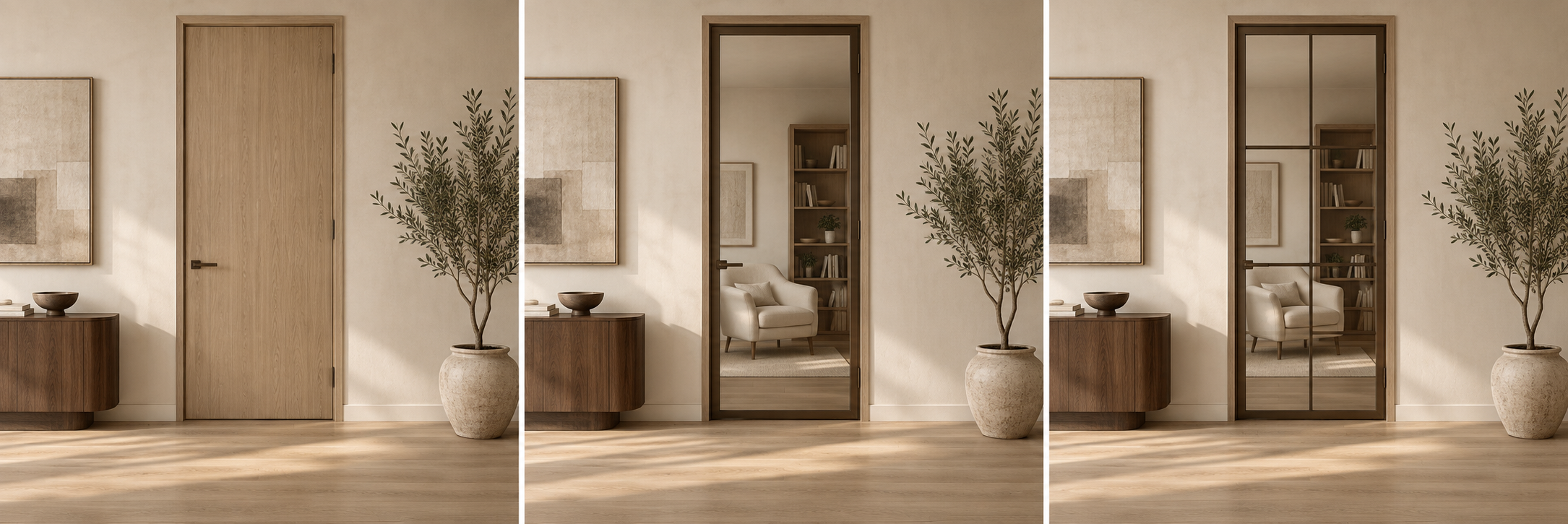
Look a little closer
Change the door. Look at what stays visible.
Solid wood
The wood surface becomes the focus and conceals the view through the panel. Ask what you want the closed door to hide.
AI-generated design concept. The panel changes illustrate visual choices, not measured light, sound or product performance.
Hold the room still. Change the opening.
It is easy to compare doors in different beautiful houses and accidentally compare the houses instead. One room has better light. Another has taller ceilings. A third has furniture you already love. The door is only one of the differences.
This concept keeps the architectural setting similar while changing the door treatment. Look first at the closed opening, then at the room beyond it. Notice how much of the background becomes part of the foreground composition. The images are a design illustration, not a controlled performance test.
The solid panel: a place for the eye to pause.
A solid panel makes the door itself the visible surface. Grain, panel proportions, color and the surrounding trim carry the composition. Storage, activity and furniture behind the closed panel drop out of the view.
That can be useful when the next space is visually busy or when you want a distinct boundary between rooms. It can also remove a view you enjoy. Stand at the usual approach to the opening and ask whether you want to look at the door or through it.
A solid panel does not by itself establish an acoustic rating. If sound is part of your brief, compare documented complete assemblies, including how they close and seal.
The clear-glass panel: the next room joins the picture.
Clear glass keeps a visual connection across a closed door. A bookshelf, desk or chair beyond it becomes part of what you see from the first room. That can create a pleasing layered view, provided the view is one you want to share.
The practical question is not simply “more light?” It is also “more of what?” A tidy reading corner and a working laundry area may lead to different decisions. Check the sightline from seated height as well as standing height. Consider how the view changes when one room is lit at night.
Glass appearance and safety specification are separate decisions. Use the door-glass guide to understand the terminology, then confirm the glazing for the selected product and application.
Divided light: a pattern across the view.
A divided-light design brings lines into the opening. Those lines can relate to nearby windows, shelving or other architectural details. The view remains, but a visible framework sits in front of it.
Look at the size and spacing of the divisions, not just their count. A fine grid, broad crossbar and simple single pane give the eye different stopping points. Ask how the pictured divisions are constructed on the exact door; similar-looking designs can use different assemblies.
Keep the rest of the room in the decision. If the surrounding space already has a strong pattern, a simpler door may make the whole composition easier to read. If the room needs definition, a framed pattern may provide it. These are design choices, not universal rules.
Choose the view you want to live with.
| Treatment | What you see when closed | Question to settle |
|---|---|---|
| Solid | The door surface | What needs to disappear behind this panel? |
| Clear glass | The door frame and the room beyond | Is that view welcome during ordinary daily use? |
| Divided-light glass | A frame pattern layered over the next room | Do the divisions work with the surrounding architecture? |
If you want shared light with less visual detail, investigate an appropriate obscured-glass option and a sample. Do not assume all patterns provide the same privacy under different lighting.
Use the room-first buying guide to write the functional brief, then explore interior doors or French doors for the configurations that suit it.
Read the full story at https://rustica.com/glass-vs-solid-interior-doors/
Keep exploring
The next good question.
 Choose well
A beautiful door can still be the wrong door.
Read story Know the details
What a product photo can’t tell you about a door.
Read story See the difference