


Compare the opening before comparing finishes
| Layout | Where the panels go | Best question to ask |
|---|---|---|
| Bypass | One panel passes in front of another. | Can every drawer and storage bay be reached through the remaining opening? |
| Bi-parting / side-parking | Panels move away from the center. | Is there clear space beside the cabinet for both leaves? |
| Single sliding panel | One leaf covers one area while exposing another. | Will the covered section remain usable when you need it? |
Check the cabinet’s structure and the panel load
Record panel width, height, thickness, material and weight, including glass or mirror. Identify whether the hardware carries the load at the top or bottom. A cabinet top that supports a shelf is not automatically suitable for a hanging door track.
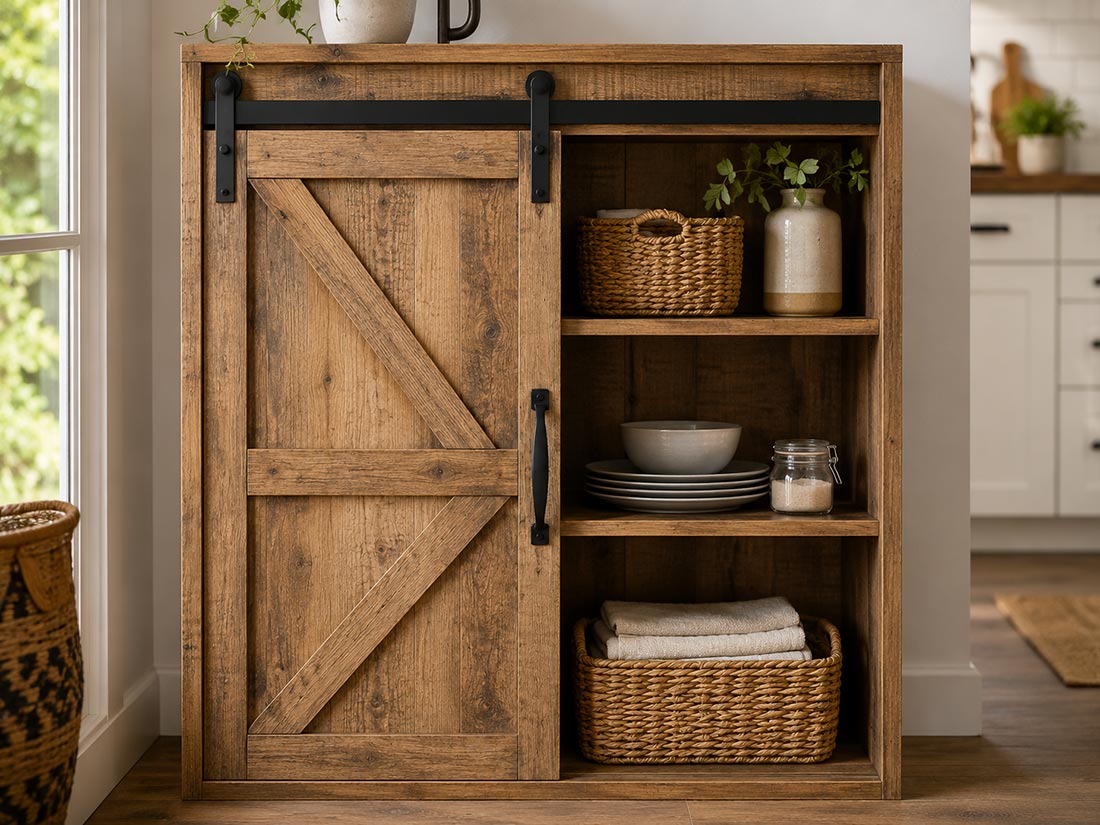
Compare the chosen cabinet barn-door hardware with the cabinet construction and available attachment. Small decorative wheels still need correctly sized hangers, guides, stops and fasteners.
Keep the operating parts in the quotation
A complete comparison includes tracks, carriers or hangers, guides, stops, retention parts, mounting hardware, pulls and any compatible soft-close or locking components. Door preparation and cabinet reinforcement may also affect the cost.
Concealed hardware and a frameless cabinet are different concepts. Hardware can be hidden within various cabinet constructions, while an exposed miniature barn-door track is deliberately visible. Choose the mechanism first and the visual treatment second.
Choose a grasping method that stays accessible
A smooth sliding face is not necessarily comfortable to operate without a pull. Check the space for fingers at the panel edge and whether the grasping point disappears behind another leaf. A projecting knob can collide with the overlapping door.
A recessed pull or an appropriate edge detail may solve the clearance problem. Test reach and force with the intended users; easy one-handed operation is a result to verify, not an automatic property of every slider.
Use sliders where they solve a specific problem
Vanity beside a narrow aisle: avoiding a swing can help, but verify access to plumbing and full-width storage baskets.
Kitchen or laundry cabinet: keep the panel stack away from the drawer or shelf you use most. Include appliance handles in the clearance check.
TV or equipment cabinet: provide the ventilation and service access required by the equipment. Closing a decorative door can change the airflow.
Playroom or utility storage: address finger traps and panel retention. Sliding edges can still pinch. If hazardous items are stored, use suitable secure storage; an ordinary cabinet latch is not automatically child-resistant.
Clean the mechanism without coating it in kitchen oil
Remove dust and loose debris with a soft cloth or the hardware maker’s approved method. Use a cleaner compatible with the finish, then remove residue as directed. Do not default to vinegar on every metal or coating.
Apply lubricant only where and when the mechanism’s instructions specify it. Olive oil is not a general hardware-maintenance specification. Some components have their own factory lubrication, and coating the entire track is not a substitute for diagnosing a damaged roller or misaligned guide.
Investigate resistance before forcing the panel
Check for trapped debris, a projecting screw, a loose guide or panel contact. If the hardware needs adjustment, use the correct installation instructions and support the panel before loosening a load-bearing connection. Confirm the stops and guides are secure after the work.
A sliding cabinet in use
Updated .