

Gold is a color description, not a material specification
A gold-colored pull may be solid brass, plated metal, coated steel or another construction. “Brushed,” “polished,” “antique” and “gold” describe different aspects of appearance, and manufacturers use their finish names differently. Read the material and finish specification instead of assuming the color tells you what the part is made from.
Sheen matters as much as hue. A reflective surface catches light and makes the hardware more prominent; a lower-sheen surface can read more softly. Two parts described as brushed brass may still differ in color, texture and reflectivity.
Compare a sample beside the door finish, wall color and nearby metalwork. Check it in daylight and under the actual lamps. A phone image is useful for narrowing choices, but it is not a reliable color standard.
A Rustica example: Casita in Modern Gold
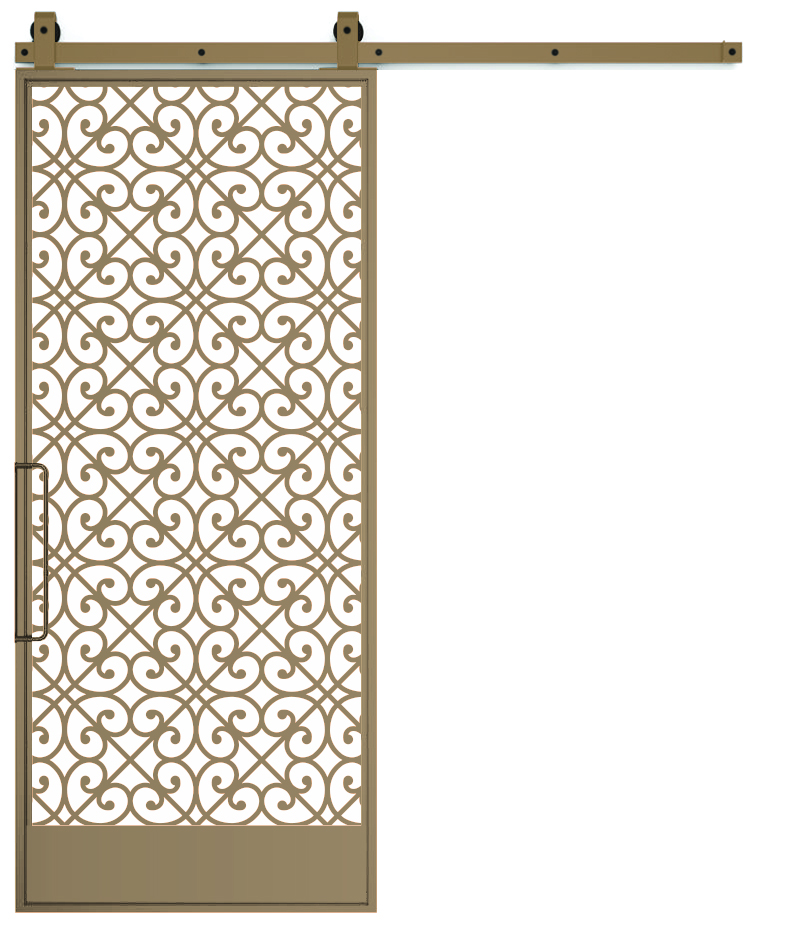
The Casita Barn Door shows how repeating a finish can bring decorative metalwork and a sliding system together. Its product caption identifies the Buck Hardware System and Carriage Pull in Modern Gold. The door’s intricate face does much of the visual work, so the simpler hanger shape gives it room to stand out.
Use this as a composition example. It does not establish that every Rustica hanger, track or accessory is available in the same finish. Confirm the current choices and the supplied parts for the exact system being ordered.
Four ways to pair gold-tone hardware with a door
White or warm off-white: gold becomes a clear accent against a quiet surface. Compare the undertone of the paint with the metal; a cool white and a strong yellow gold can create more contrast than expected.
Natural wood: let the grain remain the main texture. A simple pull and restrained hangers can sit comfortably beside busy oak grain or knotty wood. Evaluate the metal against the finished sample, since stain and clear coats change the wood’s color.
Deep green, navy or charcoal: a darker panel makes the metal more conspicuous. Check the scale of the pull from across the room, not only at arm’s length. A large wheel and a large pull together may create two competing focal points.
Glass and a slim frame: matching the frame and hardware can make the assembly read as one object. Mixed finishes can also work, but repeat the second finish elsewhere so the combination feels deliberate.
Decide how much hardware you want to see
With exposed barn-door hardware, the track forms a long horizontal line, the hangers frame the top of the door and the pull becomes the detail people touch. You do not need to make all three equally prominent.
If the door has a bold panel pattern, choose a simpler hanger silhouette. If the door is plain, a more visible wheel or strap can supply the detail. Compare the hardware at the actual door height: an oversized element may look different on a tall opening than in a close-up product photo.
For mixed metals, choose a clear relationship. Gold pulls with dark track hardware can connect to a dark door frame and warm cabinet handles. Scattering several nearly matching gold tones across one opening is harder to control than an intentional contrast.
Match the operation before the finish
A single sliding leaf, a converging pair and a bypass pair use different layouts. Identify the door weight and thickness, travel space, wall clearance and mounting support before selecting a kit. A finish match does not make parts from separate systems interchangeable.
With bypass hardware, a projecting pull can collide with the passing leaf or restrict travel. Check the overlap zone and usable grip space on both sides. The flush-pull guide is useful when the door construction and selected hardware allow a recessed option.
Include stops, guides, fastener heads and any privacy latch in the finish discussion. Some functional parts may use a different material or finish. Ask what will remain visible after installation, and request a coordinated parts list instead of relying on a styled photograph.
Care for the actual finish
Follow the hardware maker’s cleaning instructions. Do not use brass polish simply because the surface looks gold: an abrasive or chemical intended for bare brass may damage a coating or plating. Test only as permitted by the manufacturer and keep cleaners away from finishes that require different care.
If you want to refinish existing hardware, first identify the base metal, coating and moving surfaces. Painting tracks, wheel contact areas, bearings or safety components can affect operation. Obtain the manufacturer’s approved method or choose a factory-finished compatible system.
Before ordering, put the finish name, product names, system layout and visible accessories on the same specification. That small step helps turn a color idea into a door assembly that looks coherent and works as intended.
Updated September 19, 2026.