


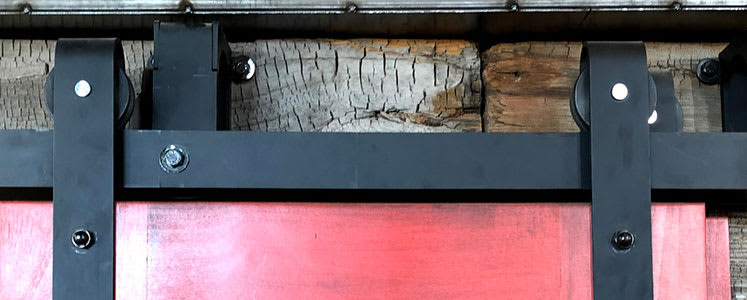
Seven parts to recognize before you order
| Part | What it does | What to check |
|---|---|---|
| Track or rail | Provides the path for the rollers. | Profile, length, mounting-hole layout and rated door size. |
| Hangers and rollers | Connect the panel to the rail and carry its weight. | Door thickness, attachment method and weight capacity. |
| Spacers | Set the distance from the wall to the track. | Door, trim, baseboard and rear-pull clearance. |
| Mounting fasteners and support | Transfer the load into the building structure. | Required blocking, studs, header and compatible fasteners. |
| Stops | Limit the door’s travel at the ends. | Position, fastening and compatibility with soft-close equipment. |
| Bottom guide | Keeps the panel from swinging away from its path. | Door groove, guide style and full-travel engagement. |
| Anti-jump device | Limits upward movement that could release a roller. | Correct placement and clearance for the selected rail. |
Track and hangers must fit each other
A flat-track roller, a tube-track hanger and a low-clearance assembly are different systems. A part that looks similar may have a different wheel profile, mounting offset or attachment pattern. Do not mix pieces from different kits without written compatibility guidance.
Start with the barn door hardware collection and the exact product’s parts list. Record the finished panel dimensions and weight, including glass, mirrors and attached hardware. A heavy door needs suitable support throughout the system, not simply a larger roller.
The header and spacers solve different problems
A mounting header can provide a suitable fastening surface when the rail layout does not align with the framing. It still needs the specified connection to structural support. Decorative trim and drywall alone are not substitutes for that support.
Spacers set the rail’s projection. Before choosing them, record the door thickness and the deepest obstruction behind the moving panel. Include baseboards, casing, switches and any rear handle. Use the system’s spacing instructions rather than a formula borrowed from a different track.
Guides, stops and anti-jump devices are separate parts
A bottom guide controls movement toward and away from the wall. An end stop controls movement along the rail. An anti-jump device limits lift. One does not replace the others, and a soft-close accessory should not be treated as a substitute for the required stops.
A grooved wood door and a glass panel may need different guides. Compare barn door guide options before choosing a mounting location. Check that the guide remains engaged when the panel is fully open and fully closed.
Use this kit checklist
- Confirm whether the order includes the rail, hangers, spacers, stops, guide, retention devices and mounting hardware.
- Check whether the door slab, pull, lock, support header and soft-close parts are separate purchases.
- Match the manual to the exact system, including bypass or bi-parting layouts.
- Have the installer confirm framing, clearances and required fasteners before drilling.
Use Rustica’s door and hardware installation instructions for the installation sequence and dimensions. The barn door measuring guide helps document the opening before ordering.
Planning a client project?
Quoting several sliding openings? Include every required hardware component in the door schedule. Rustica’s contractor discount program explains professional eligibility and how to apply.